




Quick find
With over 20 years of experience, we’ve seen that breakfast does far more than fill tummies. In SEND/ASN settings, it can be especially powerful, breaking down barriers to opportunity by supporting emotional wellbeing, learning, and independence. This spotlight shares the benefits and the key ingredients that make breakfast work in these schools, while also showing how a well-designed provision can give every child the best start in life and have long-lasting impact.
Listen to a summary, introducing you to this spotlight:
We found many positive outcomes of breakfast in SEND/ASN settings.
These can be grouped into four main themes:

- Improving social skills
- Developing practical cooking and cleaning skills
- Developing communication skills


Mental health & emotional wellbeing:
- Regulating emotions
- Increasing self-confidence and sense of belonging
- Supporting sensory needs
- Inspiring aspiration for the future

Prefer to hear about the outcomes of breakfast? Listen here:
Want to listen to the ingredients for success? Check out the audio here:
Ingredients for success
We know that breakfast only delivers its full impact when it’s done well. Through this work, we identified seven key ingredients for success: practical actions that help create the right conditions for breakfast to thrive. These come from a mix of what SEND/ASN schools are doing on the ground and the support provided by Magic Breakfast, but they could be relevant to anyone looking to make the most out breakfast:

Consistent routine in breakfast provision: Having food available at the same time every day allows children and young people to know what to expect and feel comfortable.

Buy in of the senior leadership team: Magic Breakfast works best when the senior leadership team are fully on board. This allows for all the other enablers to happen.

Creating additional resources: For children & young people with SEND/ASN, additional resources such as communication tools help make breakfast accessible.

Dedicating time to breakfast: Protecting time in the morning for breakfast means children and young people are not rushed in the morning. This helps them regulate their emotions, settle into the day and use it as a time to learn new skills.

Giving students responsibility: By involving students in the delivery and organisation of breakfast, many learning opportunities are opened and confidence and independence are developed.

Integrating learning & enrichment into breakfast: By seeing breakfast as an opportunity to support the curriculum, learning can start before lessons and resource dedicated to breakfast can be justified.

Creating different settings for breakfast: Being creative with breakfast and adjusting the settings to meet the needs of all students makes it accessible and inclusive for everyone.
Ready to dive in?
Grab a cuppa and learn all about the positive outcomes of breakfast.
Independence and life skills
Outcome: Improving social skills
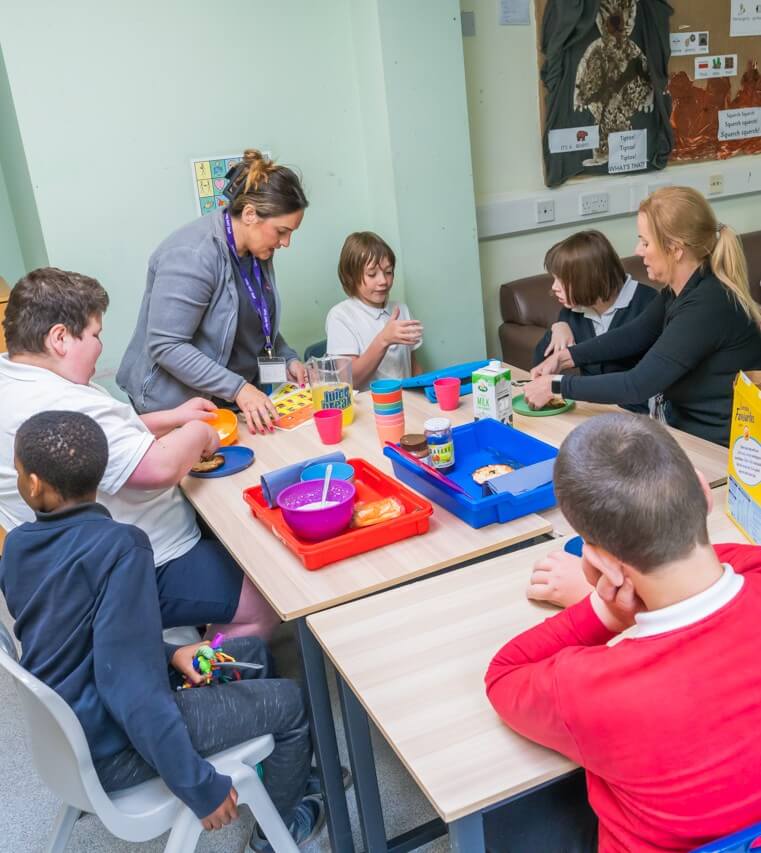
Social skills – such as making eye contact, communicating with others, or making friends – can be more difficult for children and young people with SEND/ASN. Breakfast can be a great opportunity to develop these skills. Many SEND/ASN schools have breakfast as a group, enabling positive social interactions to be modelled and practiced.
What are the ingredients for success?

Consistent routine in breakfast provision
Buy in of the senior leadership team
Creating different settings for breakfast
What do our schools say?
Mel Kirk, Vocational Lead, Nethergate Academy, Nottingham
Students at the start that we couldn’t manage to get in the hall are now coming into the hall and having their breakfast and sitting with other students, which is a massive achievement.
Elaine Padgett, Pastoral Lead, Greenacre School, Barnsley
These young people… might not get the chance very often to hang out at a café with friends and be around others like this. This is a real opportunity for them to practice these social skills before they go out into the world.
Holly O’Connor, Pupil Support Officer, Kaimes School, Edinburgh
[Our student] couldn’t talk to anyone really before. He’d always have a mask up. Couldn’t make eye contact. Now he’s working towards an SQA [Scottish Qualifications Authority] personal development award because of Magic Breakfast.
Case study corner
Discover how a canteen style breakfast for students aged 16-19 can help develop social skills by eating together as a group.

Outcome: Developing practical cooking and cleaning skills for independent living
Practical life skills – such as making breakfast, washing dishes and serving food – are key to developing independence. SEND/ASN schools want to prepare their students for life beyond education, and these skills are key in this. Many SEND/ASN schools give responsibility to students to prepare breakfast for themselves and others, allowing them to practice these skills and grow in confidence.
What are the ingredients for success?
Consistent routine in breakfast provision
Creating additional resources
Giving students responsibility

Integrating learning & enrichment into breakfast
What do our schools say?
Charlene Reid, Home School Practitioner, Saltersgate School, Dalkeith
They’re learning how to butter their own toast and cut their own toast.
Elaine Padgett, Pastoral Lead, Greenacre School, Barnsley
If they want to live on their own in supported living in the future, they need these skills to feed themselves.
Holly O’Connor, Pupil Support Officer, Kaimes School, Edinburgh
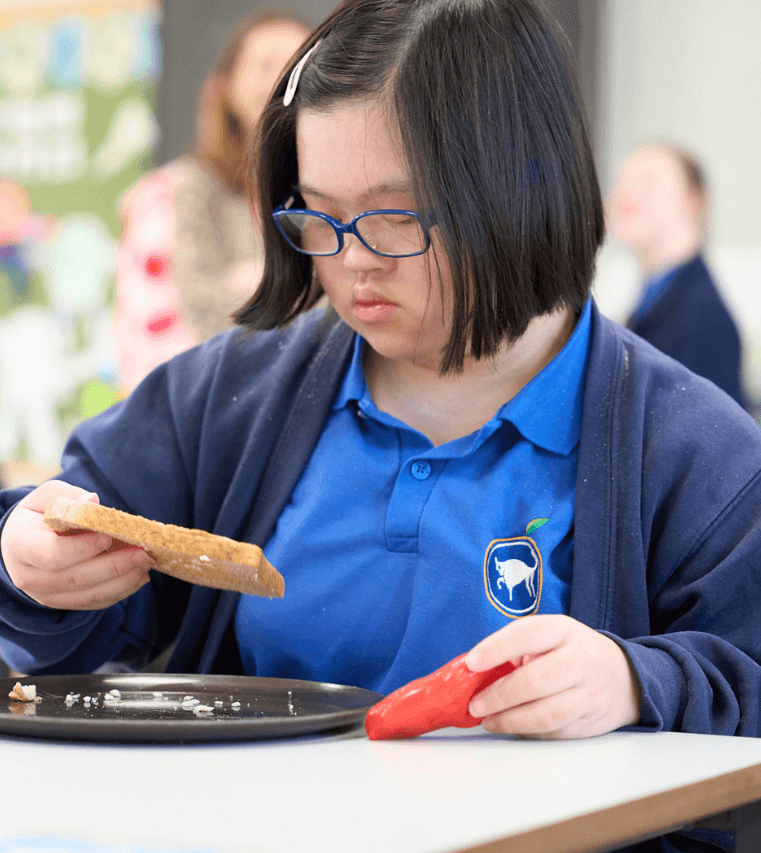
[He] didn’t know how to butter a bagel six months ago, now he’s making bagels for the whole class.
Mel Kirk, Vocational Lead, Nethergate Academy, Nottingham
They… put all the tables and chairs away, wipe everything down and wash up.
![[He] didn’t know how to butter a bagel six months ago, now he's making bagels for the whole class.](https://www.magicbreakfast.com/wp-content/uploads/RS3276_DSC03425.jpg)
Case study corner
“It’s a real team effort from sixth form. They work really hard every day to make sure that Magic Breakfast works really well.” – Mel Kirk, Vocational Lead, Nethergate Academy, Nottingham
Outcome: Developing communication skills
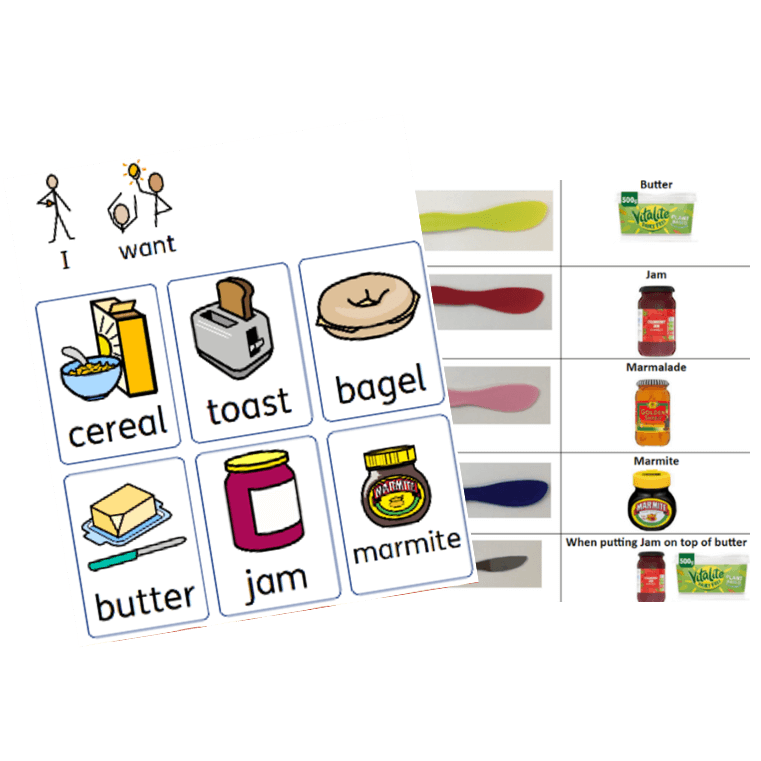
Communicating choices is vital to developing independence for children and young people with SEND/ASN. Breakfast can be an excellent opportunity to practice making choices and advocating their wants and needs. Many SEND/ASN schools develop breakfast-specific communication tools to facilitate this development.
What are the ingredients for success?
Consistent routine in breakfast provision
Creating additional resources
What do our schools say?
Mel Kirk, Vocational Lead, Nethergate Academy, Nottingham
Students that are nonverbal can come and still make their independent choices about what they’re wanting by pointing to whether they want butter, whether they want jam
Charlene Reid, Home School Practitioner, Saltersgate School, Dalkeith
We go down to each class and[the breakfast monitor] has got his communication board that he asks, ‘Would you like anything from the trolley?’
Creativity corner
Many schools help encourage independence by making extra resources and visual tools to help their students make choices and prepare food.
What does this look like?
Take a look at some of these skills in action with Kellie Bright’s visit to a SEND school in Hertfordshire.
Learning and development
Outcome: Eating a wider variety of food
Eating can be a challenge for children and young people with additional needs. They may feel dysregulated by certain textures or tastes, or have physical difficulties chewing and swallowing. It is an important part of their development to experiment with new foods, but this must be managed carefully and may take time.
With reliable access to a range of nutritious breakfast foods, SEND/ASN schools can allow children and young people to play, touch, smell and taste new food without the pressure of eating. Some schools find students sometimes even eat foods at school that they wouldn’t have tried at home.
What are the ingredients for success?
Consistent routine & breakfast provision
Dedicating time to breakfast
Creating different settings for breakfast
What do our schools say?
Sue Wale, Family Outreach Lead, Pens Meadow School, Dudley
[Our student’s] mother told us she only ate spaghetti Bolognese. [At breakfast] she ate a bagel… Now we’ve graduated from a bagel and she’s trying all sorts of fruits and everything! You can’t put a price on things like that.
Fact corner
There are many developmental stages to eating food; this starts with tolerating food and moves to interacting, smelling, touching, tasting and finally eating it.1
For many schools, Magic Breakfast is a way to explore these stages and help children and young people develop.

Outcome: Improving fine motor skills
Fine motor skills is the term used to describe movements in the hands and wrists, in particular the more refined movements in the fingers and thumbs. We use our hands on a daily basis for a variety of activities and fine motor skills are necessary for most tasks a child has to complete. They will use them during play, self-care tasks, learning and the school day.
There are many reasons children and young people may have delayed fine motor skills, from neurological conditions to physical disabilities. One way to develop these skills is to practice them, and Breakfast can be a great opportunity to do so, for instance by using cutlery to prepare and eat food every day.
What are the ingredients for success?
Consistent routine & breakfast provision
Buy in of the senior leadership team
Creating different settings for breakfast
Inspiration corner
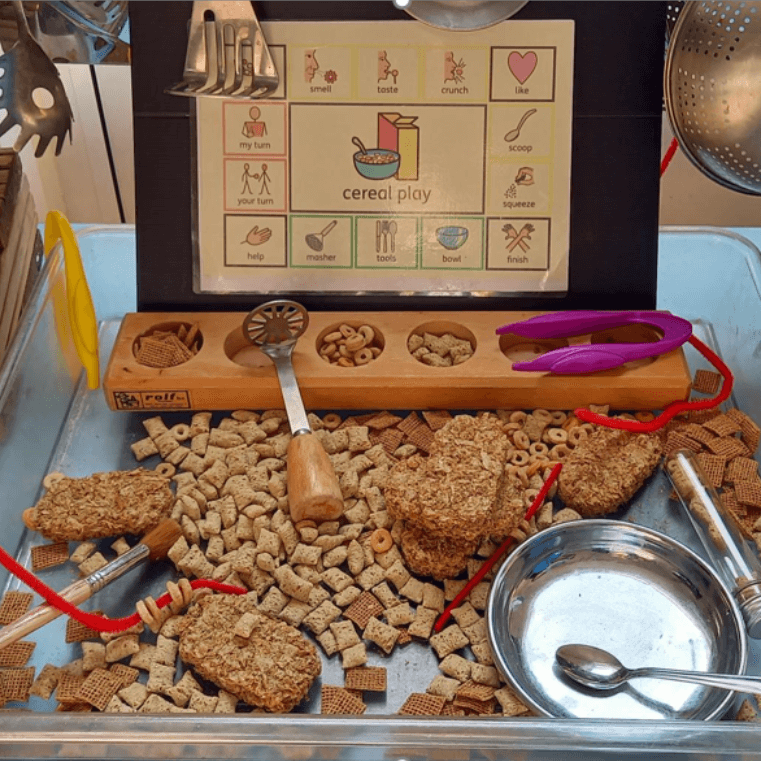
Some schools use cereal to create a sensory play experience and develop fine motor skills.
Learners can thread hoops onto pipe cleaners, stack Weetabix, or use a spoon or tweezers to develop hand strength.
Mental health & emotional wellbeing
Outcome: Regulating emotions
Emotional regulation was one of the most cited benefits of breakfast in SEND/ASN settings. Food is a common way for children and young people to regulate how they are feeling and can be a big motivator.
There are extra challenges for SEND/ASN schools in the morning, such as long transport times. Pupils may be leaving home very early, before they are ready to eat so arrive to school hungry and dysregulated. Having a routine where they can rely on a nutritious breakfast at school gives sets them up for a positive day and reduces their anxiety.
What are the ingredients for success?
Consistent routine & breakfast provision
Dedicating time to breakfast
What do our schools say?
Sue Wale, Family Outreach Lead, Pens Meadow School, Dudley
The whole reason he comes to school in the morning is because he wants his bagel and of course, if that routine didn’t happen for him, he would become extremely dysregulated. So it’s really important that our day starts with a familiar routine because you’ve got more chance of your day ending in a good way as well.
Holly O’Connor, Pupil Support Officer, Kaimes School, Edinburgh
We’ve got some [children] that are coming in a 40 minute taxi drive to even get here. So they can come in quite dysregulated. They can come in hungry, they can come in tired. So, for us to be offering their basic needs to fulfil their hunger whilst also giving them that soft start to regulate themselves, it’s just like a match made in heaven.
Fact corner
SEND pupils on average travel further to get to school than their peers to access schools that meet their needs. The Government advice is that primary pupils should be within 45 minutes and secondary 75 mins in England, but traffic, or the fact that multiple pupils need collecting along the route can increase these journey times.

Outcome: Increasing self-confidence and sense of belonging
Self-confidence and sense of belonging is developed at SEND/ASN schools through breakfast. Many schools have dedicated breakfast champions or monitors who organise and deliver breakfast to classes in the school.
Others even set up breakfast as a café, run by students. Giving students responsibility allows them to become a real part of the school community and develop confidence as well as independence.
What are the ingredients for success?
Senior leadership buy in
Giving students responsibility
Creating different settings for breakfast
What do our schools say?
Mel Kirk, Vocational Lead, Nethergate Academy, Nottingham
They enjoy the responsibility of going over there and feeling that they’re helping and doing being part of the community and supporting the other students.
Holly O’Connor, Pupil Support Officer, Kaimes School, Edinburgh
Each class is in charge of washing their dishes [and] making sure their stock is all right for the week. They get really involved with that […] because they don’t want to miss out on their breakfast.
Case study corner
Hear from a student at Kaimes school taking on the role of breakfast champion. He enjoys taking stock of what is needed and delivering food to his classroom.
“I love it because I get to see people and talk to them. I enjoy spending time out of class helping people.”

Outcome: Supporting sensory needs
Supporting sensory needs is important for SEND/ASN schools. Many children and young people with SEND/ASN may be over-sensitive or under sensitive to different sense such as taste, touch or smell. This means they may really like certain textures and flavours or really disklike them. Having a range of options for food and how they are prepared can help. For instance, listening to different preferences for how children and young people like their toast can make sure each child is catered to.
What are the ingredients for success?
Consistent routine & breakfast provision
Dedicating time to breakfast
Creating different settings for breakfast
What do our schools say?
Magic Breakfast partner SEND school, Yorkshire & Humberside
One young lady now uses breakfast as part of her regulation routine in the morning-using crunchy cereal as a method to regulate when she comes into school from the bus. This allows her to calm and settle into her day.
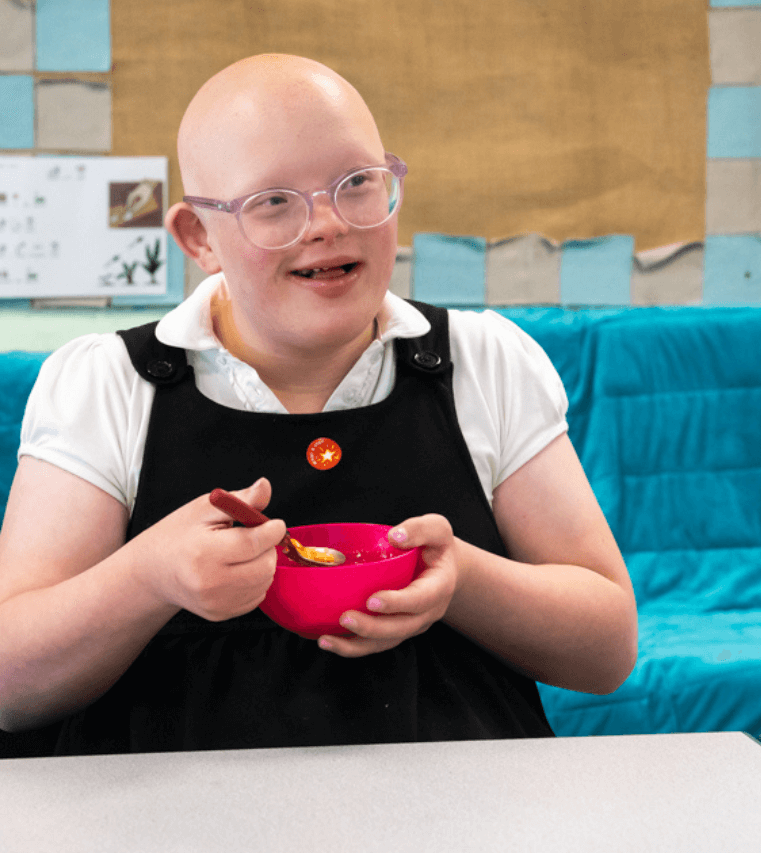
Jenny King, Magic Breakfast Community Engagement Partner
Some children love toasted bagels and with nothing else on them because they like the sensory experience of the crunchiness. Other children like dry cereal because they find the sensation calming.
Outcome: Inspiring aspiration for the future
Inspiring aspiration for the future is vital in SEND/ASN schools, where many pupils may feel uncertain or anxious about what lies ahead. To build confidence and self-belief, schools often involve students in breakfast routines; such as taking orders, preparing food, or managing supplies. These responsibilities not only foster independence but also develop practical skills that can support future employment opportunities, helping pupils see that meaningful roles and careers are within their reach.
What are the ingredients for success?
Giving students responsibility
Integrating learning & enrichment into breakfast
What do our schools say?
Mel Kirk, Vocational Lead, Nethergate Academy, Nottingham
For [those] that have never done anything like that before, they’re going ‘oh this is something I might want to do in the future and it’s something I can do in the future.’ So it’s given a real range of things for them to think about.
Holly O’Connor, Pupil Support Officer, Kaimes School, Edinburgh
We have we have breakfast club helpers so they help out, one of our seniors is working towards an SQA personal development award for helping with breakfast.
Definition corner
SQA = Scottish Qualifications Authority
SQA is responsible for educational awards. A personal development award is nationally recognized in Scotland and can be used on a CV to demonstrate a range of skills.

Family support
Outcome: Reducing family stress
Reduced stress for families with SEND/ASN children is a key benefit of universal, free breakfast. Getting children ready for school can be a battle for any family but for those with additional needs it can be even more of a challenge.
Just getting school uniform on can dysregulate children or young people with additional needs, and if children travel a long way on minibuses to get to school this can mean very early starts. So, there might not be time, or a child isn’t ready eat in the morning.
Having breakfast ready and waiting at school can massively alleviate the pressure on families as they know that their child will be fed when they arrive.
What are the ingredients for success?
Consistent routine & breakfast provision
What do our schools say?
Charlene Reid, Home School Practitioner, Saltersgate School, Dalkeith
Having that reassurance that Magic Breakfast is able to provide, that at school they’re regulated, settled and ready… it kind of takes the guilt and anxiety away… from the parents.
Parent, Saltersgate School, Dalkeith
I can’t get her to eat anything in the mornings; she just isn’t ready. It helps my anxiety to know that she will be getting something to eat when she goes to school.

Sue Wale, Family Outreach Lead, Pens Meadow School, Dudley
I don’t think you can put a price on reduced parental stress. You know, if our parents are less stressed and our children are happy, then it’s going to bring improved physical and emotional well-being to everyone.
Fact corner
Children with SEND are more likely to experience poverty than their peers2. This can be made worse by parents and caregivers needing to take more time away from work to care for their children or paying higher costs for childcare. 83% of our SEND schools agree3 that providing a breakfast can help alleviate pressure on family budgets, giving parents the security of knowing their child will be fed at school.

Case study corner
Find out how Pens Meadow School in Dudley are using breakfast sessions to help parents support their children’s learning.
Research methodology

Step 1: Internal consultation
We spoke to Magic Breakfast engagement partners to gather internal expertise.

Step 2: School engagement
We spoke to 5 SEND/ASN schools to hear how Magic Breakfast impacts pupils and families in their school community:
Kaimes School, ASN Secondary Edinburgh,
Saltersgate School, ASN all-through, Dalkeith
Nethergate Academy, SEND all-through, Nottingham
Pens Meadow, SEND all-through, Dudley
Greenacre School, SEND all-through, Barnsley

Step 3: Qualitative analysis
We analysed the qualitative data and identified common themes, outcomes and ingredients for success.

Step 4: Survey data integration
We incorporated additional findings from the Annual Breakfast Survey to support our qualitative findings.
Breakfast embedded in the curriculum
Nethergate Academy is an all-through SEND school in the East Midlands.
Mel Kirk, Vocational Lead, Nethergate Academy, Nottingham
We’ve got 172 students on roll currently… we have about 70% on the autistic spectrum. We have some complex needs students. We have a real range of students here.
Before Magic Breakfast, Nethergate had an informal breakfast offering; they offered some cereal and toast for students who said they were hungry in the morning. Now, breakfast is offered to all learners and embedded into the curriculum through learner involvement.
At Nethergate, it is the sixth form students who run the breakfast!
There are three teams of sixth formers, and each team has a different job at breakfast time. One team looks after the hall, which is set up like a café with bakery and cereal stations. A second team is on classroom delivery, and the final team clear up.
Mel shares the importance of the teams taking turns with each job:
[Team one] will ask [fellow students] what they want and then they will toast the bagels, toast the bread and they’ll butter and jam and put it all on, and then they’ll hand it to the student.
I’ve devised order forms for every class, so [team two] come into the kitchen and then the students take from those order forms what they’re having, and then every class has a box with their class teachers name on the group that they’re in, and then the orders gets delivered to their classrooms.
[Team three] come in… and put all the tables and chairs away and wipe everything down and wash up any pots that we haven’t had chance to get washed up.
Mel shares the importance of the teams taking turns with each job:
So, they’re really broadening their skills that they’re learning and not just focusing on one area… It’s a real team effort from sixth form. They work really hard every day to make sure that Magic Breakfast works really well.
Mel has worked hard to make sure the students can be as independent as possible. At an SEND school this is particularly important, as students have different communication needs. She has made visual supports in place to help students order their breakfast, and emphasises that the flexible approach the school takes is crucial to success.

Mel shares the importance of the teams taking turns with each job:
Students that are nonverbal can come and still make their independent choices about what they’re wanting by pointing to whether they want butter, whether they want jam, whether they want bread or whether they want cereals.
And then for the students that are running Magic Breakfast, there’s lots of visual clues. All coloured knives to match, to go with the butter, the jam, the Marmite, the marmalade. So they know exactly what they’re using.
School is very flexible and, although we have this model that works really well, we’ll never say that this is the final model because it’s constantly changing to adapt, to accommodate, to make sure that we’re meeting everyone’s needs.
Breakfast is about more than just food
Kaimes School is an ASN school in Edinburgh. At Kaimes, breakfast is more than just food, it’s a key part of the day and the school helps children learn to do things for themselves.
When Holly first joined three years ago, Kaimes already ran a Wednesday breakfast club, funded by the local authority, but Holly felt that offering breakfast once a week wasn’t enough.

Due to budget cuts, it was looking likely that there would be an end to the Breakfast club altogether. They didn’t want this to happen and, when looking for alternative options, found Magic Breakfast. Kaimes is now able to provide a classroom-based breakfast to their learners every day of the week.
To build on their value of independence, Kaimes has ensured each class has ownership over its breakfast. They check their food supplies every week to make sure they have what they need. The students make their breakfast themselves using toasters and kettles in their classrooms. They even help clean up and wash the dishes after.
They even have dedicated ‘Breakfast Champions’. These are learners who take responsibility for delivering food to their classroom.
Holly O’Connor, Pupil Support Officer, Kaimes School, Edinburgh
We’re not just tick boxing. Not just solely focusing on qualifications… we want to give [our learners] the tools to be equipped to live their life the best they can.
Holly interviewed one of Kaimes’ Breakfast Champions – Imran*, aged 13 – to hear how felt about his role:
I love it because I get to see people and talk to them, making it easier. It releases the stress of every class having to sort their own deliveries themselves. I can just do them with my support staff. I enjoy spending time out of class helping people… it means I can move around the school instead of sitting at a desk, getting distracted or into trouble.
Like all Magic Breakfast partner schools, the breakfast is offered to all pupils. This makes sure there is no stigma attached to feeling hungry in the morning.
Imran’s* thoughts highlight why this is so important:
I don’t eat breakfast at home because I don’t have time in the morning. I feel less rushed at school eating my breakfast and I don’t feel embarrassed as everyone else gets offered, not just me, so I don’t need to ask.
*Name changed for privacy.
Co-launching Magic Breakfast
Pens Meadow are an all-through SEND school in Dudley. They have been partnered with Magic Breakfast since 2019. When they first introduced breakfast, they wanted to embed it into the school day to maximise its impact.

Sue Wale, Family Outreach Lead, shared why this was important and how they worked with parents and carers to set up their school breakfast provision:
We were very conscious that if you parachute into people’s lives and say ‘Your child may not be eating’ or ‘Are you feeding them before school?’ that it is not going to serve you well in terms of positive relationship building.
We took families [who] would embrace the idea and we just said ‘How do we do this? How do we get all families on board?’
A group of parents got together and they took the literature which [Magic Breakfast] provided as a sort of template and they turned it into something that would meet the needs of all our families. We turned it round to:
‘Are you busy in the morning?’
‘Can life be difficult?’
‘We think it’s really important that our children have a little bit of settling into school and a little bit of social time plus the opportunity to taste food.’
And we didn’t have any resistance at all. All our families thought it was an amazing idea. After that… we got them in to trial all the breakfast and they were able to say what they thought their child might like. It just very quickly became part of universal provision and now the impact has totally been absorbed… On every young person’s timetable it is called registration and breakfast.
Our parents are very happy because they can relax knowing that if their child refuses breakfast, they’re going to have the opportunity to eat [at school].
Using breakfast to connect
Pens Meadow are an all-through SEND school in Dudley. They have been partnered with Magic Breakfast since 2019. They host family breakfasts as a way to talk to parents and carers in an open and supportive environment.
Sue Wale, Family Outreach Lead, told us how it works and the impact it can have:
We regularly invite our families in and we have a breakfast together.
And whilst we’re having a breakfast together, we do things like Makaton workshops, so that our families can take on board the communication that we do. We teach them about aided language displays. We [do] eating workshops, sleeping workshops.
Anything that helps them navigating their journey of parenting a child with SEND.
In addition, Sue shared how inviting parents & carers in for breakfast and a cup of tea creates a safe space for them to share any challenges they may be facing:
If you’re an SEND parent and you are feeling so overwhelmed and stressed and someone says, “Come and have a cup of tea and something to eat with us“, you’ve overcome a barrier just by providing that.
You can put the cup of tea there. You can put the food and then where will that conversation take you?
‘I had an awful weekend. I didn’t get any sleep, I’m really worried about this, this and this.’
It’s an inclusive gateway to lots of other things.
- SOS Approach to Feeding – Core Principles, sosapproachtofeeding.com/sos-approach-feeding-core-principles
- Joseph Rowntree Foundation, Special educational needs and their links to poverty, www.jrf.org.uk/child-poverty/special-educational-needs-and-their-links-to-poverty
- Magic Breakfast, Annual Breakfast Survey 2025, www.magicbreakfast.com/annual-breakfast-survey