
What is deep material poverty?
In May 2025, we shared three important ideas that help us understand poverty and how it affects children and young people:
- Relative income poverty: when a family has less money than most other families.
- Material deprivation: when a family can’t afford the things they need.
- Food insecurity: when a family doesn’t always have enough food.
In December 2025, the UK government added a new way to measure poverty called deep material poverty. This helps us see how many children and young people are living in the hardest situations.
What does living in deep material poverty mean?
A child living in deep material poverty may experience:
- A cold home because their family can’t afford heating
- Not being able to get to school because the bus costs too much
- No place to do homework
- Not having three meals a day
In our Annual Breakfast Survey, we heard from schools on what this looks like for their communities:
Children’s relationships and attendance are suffering as families struggle, leaving some pupils unable to get to school or fit in.”
Magic Breakfast partner school, South East
Sometimes we don’t have much at home until Mum gets paid. I don’t like asking. It’s easier to just wait until lunchtime.”
Pupil, age 13, Magic Breakfast partner school, Greater London
How is deep material poverty measured?
Every year, a sample of UK households answer questions, set by the Department for Work and Pensions, about their home and family finances.
There are 13 essential needs, if a family can’t meet more than 4, they are counted as being in deep material poverty.
Some of these needs include:
- Paying bills
- Keeping the home warm and safe
- Repairing broken appliances
- Children eating three meals a day
- Having clothes that fit
How does this new measure reflect the experience of families?
As we have already outlined, poverty isn’t just about income, so it is important to look at these other measures to understand what people are experiencing. Different families can have very different experiences, but both still be facing challenges.
For example:
- One family may earn enough on paper but still face deep material poverty and food insecurity because they have to cut back on food to pay for bills, transport to work or emergency repairs in their home.
- Another family may earn less and worry a lot about money but are not classed as experiencing deep material poverty because they can walk to work, get help from relatives, or live near shops with affordable food.
Deep material poverty helps show these differences so that solutions can be found that support those most in need.
What does this mean for Magic Breakfast?
The government introduced deep material poverty as a new measure to better track efforts to reduce child poverty. This aligns closely with our Nourishing Futures strategy and our vision of a UK where every child is nourished, empowered, and thriving.
Deep material poverty highlights the day to day challenges many children face at home; cold housing, unaffordable transport, lack of food, and limited access to the essentials needed to learn and grow. These are the realities we see across our partner schools, and they reinforce why our work matters.
Two of our core strategic goals link closely to this:
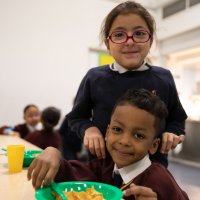
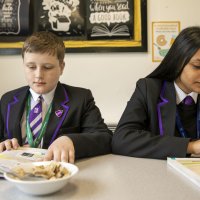
Children and young people living in deep material poverty often rely on school for warmth, routine, care, and a dependable meal. By providing a stigma-free, healthy breakfast, we help remove a key barrier so they can start the day ready to learn. Positive progress is being made, with the UK Government continuing to roll out free school breakfast clubs for every primary-aged pupil in England and the Scottish Government’s recent commitment to fund breakfast clubs for every primary and ASN school.
However, not all children and young people currently benefit from these schemes. Many schools fall outside the criteria, and some communities experiencing high levels of hardship are still not reached. Measures like deep material poverty help us understand where gaps remain in the system and how well current approaches are working overall. They strengthen the case for expanding access so that more pupils who would benefit from a nourishing breakfast are included.
Deep material poverty helps us understand the many pressures families face and why children and young people may be coming to school hungry.
By working closely with schools, the wider sector, policymakers, and partners, we can ensure that children and young people do not face these challenges alone. Insights from measures like this help us understand families’ realities, influence meaningful change, and shape our programmes. They also strengthen our advocacy, enabling us to highlight the wider benefits of school breakfast provision, helping every child and young person to be nourished, empowered, and able to thrive.
Related content
A spotlight on breakfast in SEND/ASN schools
With over 20 years of experience, we’ve seen that breakfast does far more than fill… Read more
![[He] didn’t know how to butter a bagel six months ago, now he's making bagels for the whole class.](https://www.magicbreakfast.com/wp-content/uploads/RS3276_DSC03425-e1760108621955-500x500.jpg)
How school breakfast helps children with SEND develop new social skills
We know that the magic of breakfast exists beyond the food. With over 20 years… Read more