
Each year, the UK Government publishes its Households Below Average Income (HBAI) statistics.1 This is the main way poverty is measured in the UK. These statistics help everyone understand who needs support and shape policymaking decisions.
Last week marked the release of the data for the last financial year (April 2024-April 2025). This revealed that 4 million children and young people are experiencing relative income poverty. That’s equivalent to eight in a classroom of thirty.
Last year this figure was 4.5 million. This may make it seem like poverty levels are dropping. However, the UK Government has changed how they calculate some of the data. When we adjust for these changes, we find that the figure would have been 4 million last year too.
This means that there has been no reduction in the level of children and young people living in relative income poverty. In other words, no real progress has been made yet.
It is noticeable that many children do not have appropriate footwear and warm or weather proof coats. We assume that families are facing fuel poverty as some children’s clothes have a damp smell which is more noticeable in cold wet weather.”
Magic Breakfast partner school, Scotland
What has changed in the HBAI statistics?
In the past, some benefit income was underreported in surveys. But for the first time, the UK Government has combined administrative data on benefits with the survey. Including this extra information makes the data more accurate. This is good as it helps us better understand why children and young people are starting the day hungry.
What about the other measures of poverty?
Alongside relative income poverty, data on the other measures of hardship including deep material poverty was also released. Some of these suggest we may be moving in the right direction. For example, fewer children are accessing food banks, and levels of material deprivation have fallen. Yet these can mask the depth of poverty that many children are still experiencing. In February, we discussed deep material poverty as a key measure for understanding acute hardship. This includes experiences such as not having three meals a day or living in a home that is cold or damp.
Despite a small decrease compared to last year, 1.9 million children (down from 2 million) are experiencing deep material poverty. That’s one in eight children in the UK. This level of hardship has lasting impacts on children’s lives. It also reflects the severe inequalities that still exist in the UK.
These inequalities are visible in the food children and young people eat. We know that healthier foods cost, on average, twice as much as less healthy options.2 This makes them harder to access for families on lower incomes.
As a result, in the lowest-income families, one in ten children do not eat fresh fruit or vegetables every day. In contrast, in the highest-income families, only one in fifty children miss out. Without enough fruit and vegetables, it is harder for children to stay healthy and get the nutrients they need to grow. This limits their ability to learn and thrive, now and in the future.
What other inequality does the data reveal?
As in previous years, some children are more at risk of experiencing poverty than others. Of the 1.9 million children experiencing deep material poverty:
- 49% live in a household with three or more children (compared to 32% of the population)
- 50% live in lone-parent households (compared to 24% of the population)
- 56% live in a household where someone is disabled (compared to 39% of the population)
It is also important to understand that poverty is not confined to families out of work. 62% of children experiencing deep material poverty are in working families. Rising housing, food and energy costs combined with insecure or low paid work, mean that income does not stretch far enough to cover the basics. This leaves families vulnerable to financial shocks.
What does this mean for schools?
Behind every number is a child starting their school day hungry, anxious, or exhausted. Staff, parents, and pupils from our partner schools have told us about the impact of poverty on them.
I feel hungry and my tummy hurts when I do not have breakfast or there is no food in the house. I cannot concentrate on my learning.”
Pupil, Magic Breakfast partner school, North West
I do not have the money to provide a healthy breakfast for my child. I try my best!”
Parent of a pupil at a Magic Breakfast partner school, North West
Pupils are more anxious, distracted, or emotionally dysregulated. In many cases, this is linked to stress within the home, such as overcrowding, parental mental health issues, or financial pressure.”
Magic Breakfast partner school, West Midlands
Why does this data matter to Magic Breakfast?
At Magic Breakfast, we care about this data because poverty is a major root cause of child morning hunger. When families are under pressure, food is often one of the first things to get rationed or skipped altogether. This means breakfast is not guaranteed, yet we believe it is essential for children’s health, wellbeing, and ability to learn.
We support over 1,000 schools to provide nourishing and stigma-free breakfast provisions. This helps ensure that children and young people can start the day ready to learn, whatever their circumstances.
But we know that providing breakfast alone is not the solution. We want to see a UK where every child is nourished, empowered and thriving, and these statistics underline the urgent need for action that tackles the root causes of child morning hunger.
Related content
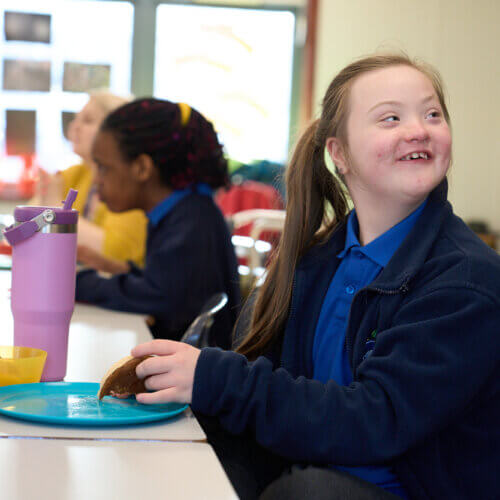
A spotlight on breakfast in SEND/ASN schools
With over 20 years of experience, we’ve seen that breakfast does far more than fill… Read more
![[He] didn’t know how to butter a bagel six months ago, now he's making bagels for the whole class.](https://www.magicbreakfast.com/wp-content/uploads/RS3276_DSC03425-e1760108621955-500x500.jpg)
How school breakfast helps children with SEND develop new social skills
We know that the magic of breakfast exists beyond the food. With over 20 years… Read more
- Department for Work and Pensions. UK Government [Internet]. 2026 [cited 2026 Mar 31]. Households Below Average Income: An analysis of the UK income distribution: FYE 1995 to FYE 2025. Available from: https://www.gov.uk/government/statistics/households-below-average-income-for-financial-years-ending-1995-to-2025/households-below-average-income-an-analysis-of-the-uk-income-distribution-fye-1995-to-fye-2025#children-in-low-income-households
- Davies Z, Pombo S, Hayman J, Bremner D, Farmer B, Dore De Jong Q:, et al. The Broken Plate 2025: The state of the Nation’s Food System [Internet]. 2025 [cited 2025 Sep 18]. Report. Available from: https://foodfoundation.org.uk/publication/broken-plate-2025