



There are few days quite like results day. This summer, young people across England have received their A-level and GCSE results, marking an important milestone as they consider what comes next. Everyone at Magic Breakfast sends their congratulations to every student receiving their results, especially those in our partner schools across England.
Our latest research shows that young people who have breakfast are healthier and happier, can builder stronger relationships and achieve better academic results, supporting them to approach the world with confidence and curiosity.
However, results day also shines a light on the inequalities that continue to impact educational outcomes and future life chances. If we are to achieve the Government’s ambition of breaking down barriers to opportunity and reducing the disadvantage gap, we must address these inequalities within the education system.
Today’s GCSE results show that educational outcomes remain unequal across England, with inequalities persisting across communities and regions: London recorded the highest proportion of results at grade 4 and above (71.7%) and grade 7 and above (28.6%), while the North East recorded the lowest proportion of grade 7s and above (17.7%) and the West Midlands recorded the lowest proportion of grade 4s and above (62.5%). This is not a new trend. The Sutton Trust’s Opportunity Index highlighted significant geographical disparities in GCSE attainment across England in 2023/24. Most notably, it showed a 30 percentage point gap in the proportion of pupils eligible for Free School Meals achieving GCSE grade 5 or above in English and maths between the highest ranked area (45%) and the lowest ranked area (15%).
These inequalities begin long before exams. The Education Policy Institute reported that, in 2025, there was a 4.9-month disadvantage gap for pupils in Reception against their counterparts, the widest gap reported since 2014.
Schools consistently tell us that hunger is one of the barriers to learning. Our latest Annual Breakfast Survey found that 93% of partner schools say hunger makes it harder for pupils to learn and do well at school, while 86% agree that school breakfast makes a real difference to learning and educational attainment. Among partner secondary schools in England, 85% say school breakfast supports test and exam readiness.
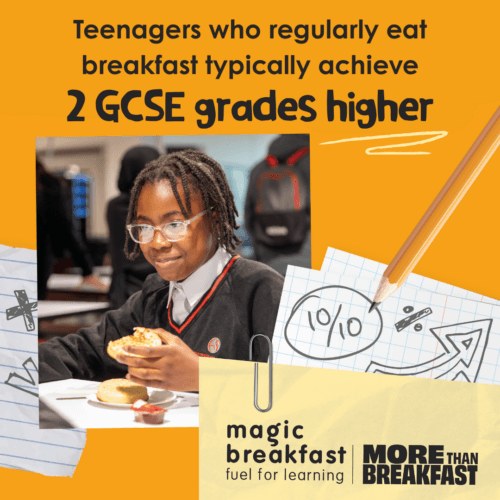
Research supports what schools consistently tell us. A University of Leeds study found that pupils who regularly eat breakfast achieve, on average, two GCSE grades higher than those who do not. This demonstrates its potential to support attainment and exam readiness.
Just as the disadvantage gap begins long before GCSEs, so do the benefits of school breakfast provision. Independent evidence from the Education Endowment Foundation found that Year 2 children in schools with breakfast provision made the equivalent of two months’ additional academic progress in key subjects including English and Maths. This reinforces the benefits of access to school breakfast throughout a pupils’ educational journey, including secondary school.
Breakfast is therefore much more than the meal itself. As our More Than Breakfast campaign highlights, when schools offer breakfast, they give teenagers a safe space to spend time with people they know and eat a nourishing meal before the day begins. Our latest research shows that young people who have breakfast are healthier and happier, can builder stronger relationships and achieve better academic results, supporting them to approach the world with confidence and curiosity.
This matters particularly during adolescence, when diet quality deteriorates most and breakfast consumption is at its lowest. At a crucial moment in the lives of young people, skipping breakfast can undermine health and wellbeing, make it harder to engage in school and affect future opportunities.
Hunger doesn’t stop at 11, and neither do the tenfold benefits of breakfast. With the Government rolling out the Free Breakfast Club Programme across primary schools and current support for secondary schools uncertain beyond 2026, there is a real risk the gap will widen for secondary-aged pupils.
That is why we are calling on the Government to not only deliver its commitment to roll out the Free Breakfast Club Programme across all primary schools in England, but extend the programme to include secondary-aged pupils. As we celebrate today’s successes, we should also look at what needs to happen next. We’re seeking cross-party support from MPs to:
- Make sure every secondary pupil has access to a nutritious breakfast at school, so hunger is not a barrier to learning.
- Deliver on the Government’s commitment to roll out the Free Breakfast Club Programme in all primary schools in England.
- Ensure the Free Breakfast Club Programme is accessible to all pupils, with guidance and funding enabling schools and Local Authorities to provide inclusive provision and transport arrangements, meeting the needs of pupils with SEND and their families.
Pupils return to school in less than two weeks. For pupils moving from Year 6 to secondary school, this transition could mean losing access to a free breakfast offer. As breakfast provision expands in primary schools through the Free Breakfast Club Programme, it is important that secondary-aged pupils are not left behind.
Our More Than Breakfast campaign highlights the significant benefits associated with school breakfast for young people. As the programme continues to roll out across England, thousands of teenagers will continue to miss out. So, while we celebrate today’s successes, we continue to advocate for every young person to have the opportunity to learn and thrive.
Related content

Fuel their learning, their exam success, and their future potential
How a nutritious breakfast supports learning Thousands of students up and down the country will… Read more
Fuelling change: insights from the 2025 Party Conference season
As the autumn Party Conference season comes to a close, Magic Breakfast takes a moment… Read more